
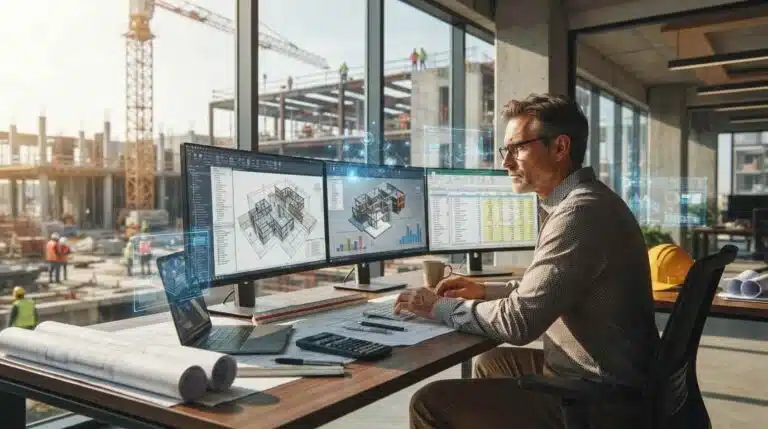
Cost overruns still sink too many projects. That’s exactly why AI construction cost estimating has moved from a niche experiment to a real conversation in preconstruction meetings and on job sites everywhere. Estimators are asking a fair question: do these tools actually help, or do they just add another layer of software to babysit?
The pressure is real. Labor is tight. Material prices swing without warning. Bid deadlines never move, no matter what’s happening in the supply chain. Contractors want faster numbers they can trust — and AI construction cost estimating keeps promising exactly that.
This article breaks down the benefits, the risks, and the honest limits of these tools. No hype, no sales pitch. Just what you need to know before deciding whether AI construction cost estimating belongs in your workflow.
What Is AI Construction Cost Estimating?
Cost estimating is the process of predicting how much a project will cost before you build it — labor, materials, equipment, overhead, all of it. AI construction cost estimating uses software trained on large sets of project data to help produce those numbers faster than a person working alone.
Instead of relying only on spreadsheets and manual lookups, the software hunts for patterns. It compares your project to past jobs with similar scope. Then it suggests costs based on what comparable work has actually required, not just a rough guess.
Think of it as a very fast assistant, not a replacement for judgment. It handles the repetitive number-crunching so you can spend your time on the decisions that actually need a person behind them.
This shift is part of a bigger trend in AI construction estimating, where firms are testing technology across the entire preconstruction phase. Cost estimating just happens to be one of the first places that value shows up clearly.
How Does AI Cost Estimation Actually Work?
AI cost estimation learns from data. The more historical project information it has to work with, the sharper its suggestions tend to be. That data usually includes past bids, actual final costs, material prices, and productivity rates from real jobs.
Here’s the basic flow. You feed the system your project details. It scans similar past projects in its database. Then it produces a cost range or a line-item estimate for your team to review — not to accept blindly.
Many of these tools pull directly from digital plans, too. They read drawings and measure quantities on their own. This automated measuring is often called AI material takeoff, and it feeds clean quantity data straight into the cost calculation without a person manually counting first.
But the software doesn’t think like a person, and that’s worth being blunt about. It spots patterns and runs the math. It can’t walk a site, sense that a client is difficult to work with, or notice that a subcontractor’s number looks suspiciously low. That gap matters. We’ll come back to it.
AI Project Cost Estimation: What Changes on Larger Jobs?
Small jobs are fairly simple to estimate by hand. Large ones aren’t. AI project cost estimation shows its strongest value once the scope gets complex and the variables start piling up fast.
On a big commercial build, you might be tracking thousands of line items across dozens of trade packages. Manual estimating at that scale invites mistakes — a single missed quantity buried in page 40 of a drawing set can throw off the entire bid.
AI project cost estimation helps by processing that volume quickly and flagging gaps before they become a problem. It checks quantities against the plans, keeps numbers consistent across the estimate, and surfaces line items that look out of range compared to similar past jobs. As a result, your team spends less time hunting for errors buried somewhere in a 300-page spreadsheet.
Speed matters here too, more than people sometimes admit. Picture a general contractor with three active bids due the same week — a hospital renovation, a mid-rise apartment build, and a warehouse expansion. Estimating all three by hand with a small team means something gives, usually sleep or thoroughness. AI project cost estimation lets that same team produce solid first-pass numbers on all three, then spend their real hours refining the bid most likely to win.
Is AI for Construction Estimating Worth Adopting Right Now?
The honest answer depends on your workflow. AI for construction estimating is maturing fast, but it’s not a plug-and-play fix for every shop that tries it. You need decent historical data, and you need a team willing to actually change how they work.
The benefits are real when the fit is right — faster estimates, fewer manual errors, more consistent numbers project to project. Industry reports suggest firms adopting these tools often see meaningful time savings on the more repetitive estimating tasks, though results vary by firm and by how clean the underlying data is.
Adoption still takes real effort, though. Someone has to clean the data, learn the software, and check its output line by line, at least at first. That learning curve is genuine, especially for smaller teams without a dedicated tech person.
If you’re asking can AI improve construction estimating for your firm specifically, don’t roll it out everywhere at once. Test AI for construction estimating on one project type first. Expand once you actually trust the results, not before.
How Reliable Is AI in Construction Estimating Today?
Reliability is the question every estimator eventually asks. AI in construction estimating can produce strong numbers, but only when the input data is good. Feed it messy or thin data, and the output suffers right along with it.
The old rule still holds here: garbage in, garbage out. These tools learn from your history. If that history is incomplete or outdated, the estimates will carry those same gaps forward.
There’s another limit worth naming plainly. AI in construction estimating struggles with anything truly new — a first-of-its-kind design, an unusual site condition, a material nobody’s used on a project like this before. None of that has a clear match in the training data. In those cases, human experience still wins, and probably will for a long time.
So treat the output as a starting point, not a final answer. The best results come when a seasoned estimator reviews every number before it goes anywhere near a client. The software speeds things up. You still own the decision, and you still sign your name to it.
What Should You Look for in AI Cost Estimation Software?
Not all tools are built the same, and the differences matter more than the marketing suggests. When you compare AI cost estimation software, focus on how well it fits your actual workflow — not on whichever tool has the flashiest feature list.
Data control matters most: you should be able to use your own historical costs, not just generic industry averages that don’t reflect your region or your crews.
Transparency matters too — the tool should show how it reached a number, so you can actually check its logic instead of trusting a black box.
Integration is another practical concern. Good AI cost estimation software connects with the plans, spreadsheets, and systems your team already uses daily.
Ease of use decides whether the tool gets adopted at all. If your team dreads opening it, it’ll collect dust within a month.
Ask hard questions during any demo, and don’t accept vague answers.
Questions to Ask Before Choosing a Tool
Where does the cost data actually come from?
How often is it updated?
Can you override its suggestions easily when you know something the software doesn’t?
Does the vendor help you set up the system and clean your data properly?
Support matters here too because the software is only half the job.
What Are the Real Risks of Relying on AI for Cost Estimates?
Every tool carries risk, and this one is no exception. The biggest danger, by far, is trusting the output without checking it carefully. A confident-looking number on a screen can still be dead wrong.
Overreliance is the real trap. When teams stop reviewing estimates line by line, small errors slip through unnoticed. Those errors can turn into lost margin on a job you already won, or a bid you shouldn’t have submitted in the first place.
Data quality is another genuine risk. If your cost data is outdated, the estimate built on it will be too. Material prices shift constantly, and the software only knows what it’s been fed — it has no idea steel jumped 12% last month unless someone updated that information.
There’s a skills concern worth taking seriously as well. Newer estimators need to learn the fundamentals by hand first, before leaning on automation. If they skip that step and lean on the software too early, they may never build the instinct to catch a number that’s just plain wrong. The tool should support judgment. It shouldn’t replace the need to build it in the first place.
What Does This Mean for Contractors and Estimators Going Forward?
The direction here is pretty clear. These tools are getting better, cheaper, and more common every year, not less. Contractors who understand them early will have a real advantage over those who wait and hope the trend fades.
That doesn’t mean rushing in blindly. It means learning the technology while keeping your core estimating skills sharp underneath it. The estimators who do best going forward will pair real experience with smart tools, not replace one with the other.
More firms are already moving this direction. Some businesses that offer estimating as a dedicated service — working as an outside construction cost estimator for other contractors who don’t want to build an in-house team — are adopting these tools to handle a lot more volume without adding headcount. That trend will likely keep spreading as the software matures.
The takeaway is simple enough. Stay curious, test carefully, and keep a human in charge of the final number every single time. Used well, AI construction cost estimating supports your team’s judgment. Used carelessly, it creates expensive surprises that show up months after the contract is signed.
Frequently Asked Questions
How accurate is AI construction cost estimating?
Accuracy depends heavily on the quality of your data. With clean, current cost history, AI construction cost estimating can produce reliable ranges for review. Without good data behind it, the numbers need heavy correction, so a human check stays essential either way.
What is AI construction cost estimating used for?
It’s used to speed up cost predictions, measure quantities from plans, and keep estimates consistent across projects. AI construction cost estimating handles the repetitive math so estimators can focus on judgment and strategy instead. It works best as a support tool, not a replacement for one.
Can AI replace a human estimator?
No. These tools handle volume and speed well, but they can’t walk a site or read a difficult client. Experienced estimators are still needed to review the numbers and account for the unusual details software tends to miss entirely.
Is AI cost estimating expensive to start using?
Costs vary widely depending on the tool and the size of your firm. Many teams start with a small pilot on one project type to test the fit before committing to a full rollout. That approach keeps upfront risk low while your team actually learns what works.
The Practical Next Step
These tools aren’t magic, and they’re not a threat to skilled estimators either. They’re a way to work faster and catch more errors, as long as you keep control of the final number yourself. The firms that come out ahead will treat this technology as a partner, not a shortcut around real expertise.
If you’re curious, start with one clear step. Pick a single project type and run a small test. Compare the software’s output against a hand estimate you already trust, line by line. Then judge the results honestly for yourself, not based on what the vendor promised.
Clean data is where the real value begins, so tidy up your cost history before you start anything else. Learn the tools, keep your judgment sharp, and stay honest about the limits you find along the way. Done right, this shift can make your estimating stronger without giving up the experience that got you here in the first place.