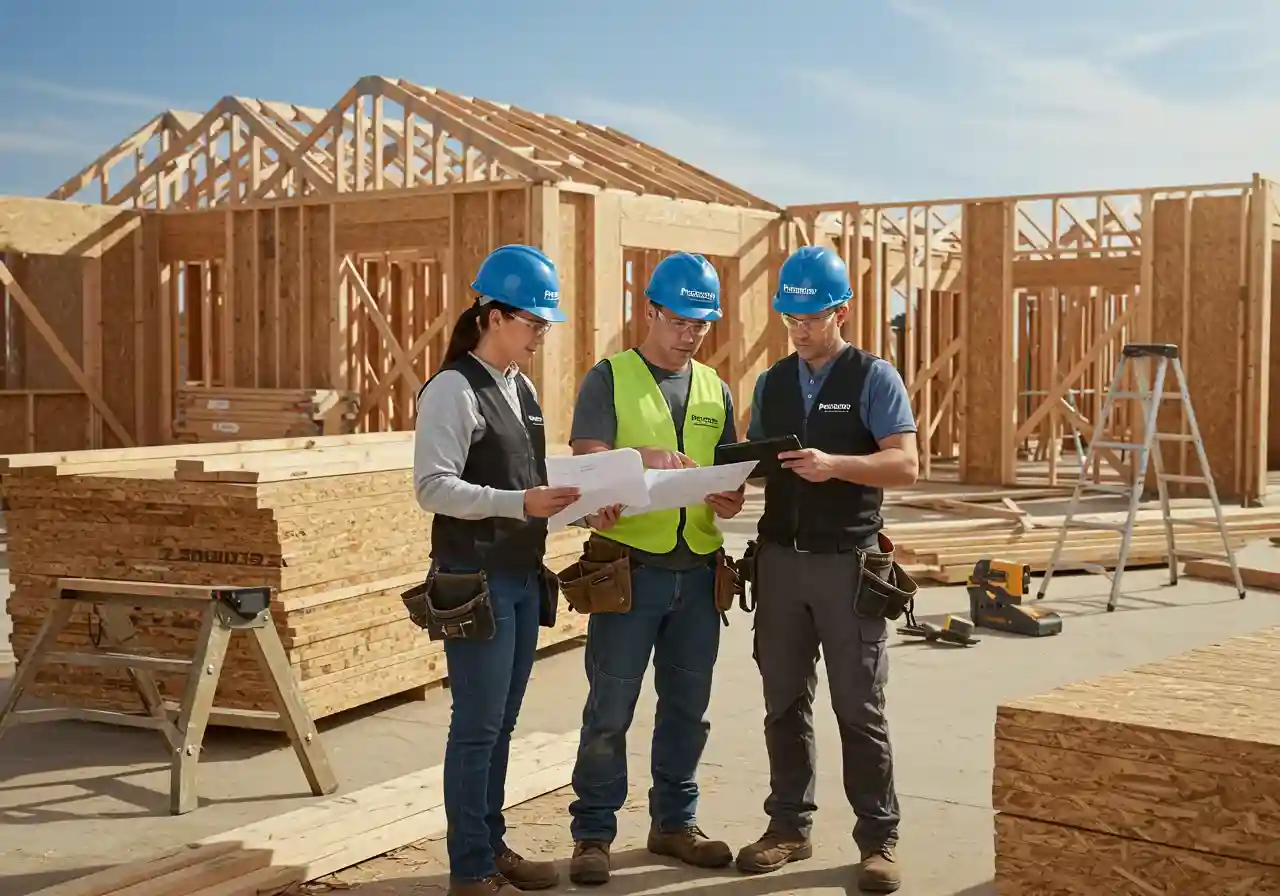
Accurate Lumber Takeoff Services for Your Construction Project
Getting your lumber order wrong isn’t just an inconvenience — it’s expensive. A short delivery stops your framers cold, forces emergency orders at retail pricing, and pushes your schedule back in ways that affect every trade behind you. Over-order and you’re paying to haul off material that warped sitting on a pallet in the rain. A solid lumber takeoff deals with both problems before they have a chance to cost you.
At ProEstimatrix, we pull material counts directly from your architectural and structural drawings. Wall studs, headers, joists, beams, rim boards, panel products — everything gets counted, organized, and handed back to you in a format your purchasing team can act on. We don’t use square-footage shortcuts or fill gaps with assumptions. The quantities come from your plans, full stop.
We work with contractors, builders, developers, and project managers across the United States. Custom homes, multifamily projects, light commercial builds — whatever the scope, our estimates reflect what your job actually requires. Fewer shortages, less waste, and a bid number that holds up when someone asks you to back it up.
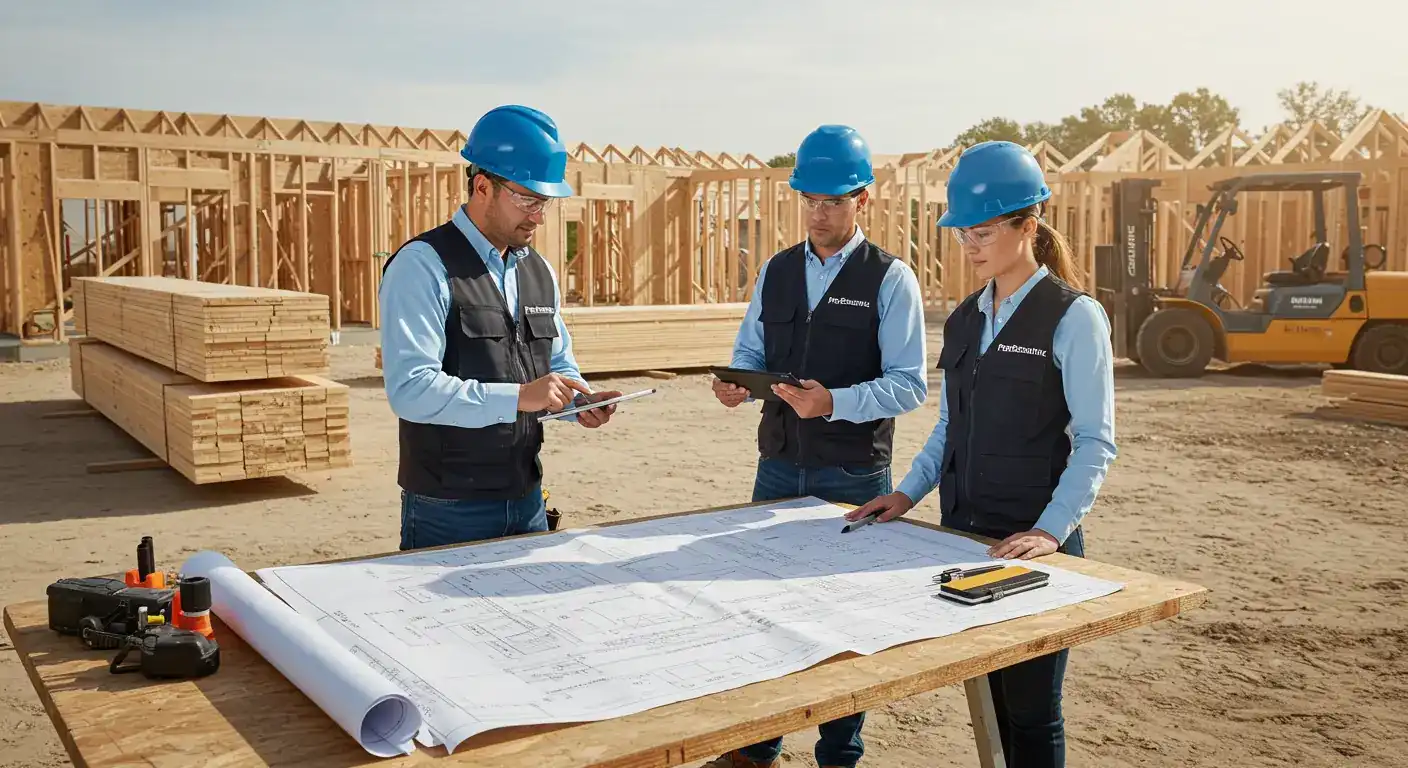
Want an Accurate Construction Quote?
Share your project info today and receive detailed material lists, pricing breakdowns, and proposal support to help you bid successfully.
What Our Lumber Takeoff Reports Include
No two framing jobs are the same, which is exactly why ProEstimatrix builds every report from scratch. Your drawings, your scope — not a template with your project name swapped in.
Wall framing quantities list bottom plates, top plates, studs, headers, king studs, and cripples by size, length, and species. Floor framing covers joists, rim boards, blocking, and bridging. Roof framing gets broken out member by member: common rafters, hip and valley rafters, ridge boards, collar ties, ceiling joists. Deck framing and stair stringers go in wherever the scope calls for them.
Plywood and OSB are measured for subfloor, wall sheathing, and roof decking with waste factors built in. Engineered products — LVL beams, I-joists, LSL headers — get their own schedule with spans, depths, and load data so your supplier isn’t guessing at what you need.
Material type and dimension run through the whole report. If your drawings call for SPF dimensional lumber, pressure-treated sill plates, or Douglas fir timbers, that’s what shows up in the count. No substitutions, no rounding up to the nearest convenient size.
How Lumber Estimating Helps Construction Teams
A material error on a framing project doesn’t stay in one place. Run short on floor joists mid-week and your crew idles, an emergency order goes out at whatever price the supplier wants to charge, and the trades behind you are already getting phone calls about schedule changes. Overordering has its own costs — extra material taking up space, warping outside, and needing disposal.
ProEstimatrix reports connect what’s on the plan to what gets ordered. Quantities are broken down by framing assembly so purchasing and scheduling work together instead of chasing each other. Framers cut from a documented list rather than eyeballing it, and that alone cuts off-cut waste and keeps the site from becoming a mess.
What contractors see in practice:
- Material deliveries and crew schedules that line up, because the quantities are accurate enough to plan around
- Less wasted lumber because counts reflect actual framing conditions rather than ballpark estimates
- Lower disposal costs with fewer excess materials to haul off
- Fewer trips back to the supplier because gaps get caught at the estimate stage, not after delivery
Who Uses Lumber Quantity Takeoff Services
Lumber estimating isn’t something only large firms with dedicated estimating departments can justify. Contractors and project teams at every scale use accurate material counts to avoid the problems that come from guessing.
Framing subcontractors use lumber quantity takeoff reports to put a real material cost on the table before they commit to a number. No padding built in to cover uncertainty. General contractors use independent estimates to evaluate what their framing subs are bidding. When one number comes in 20% below the field, a reliable takeoff tells you whether that’s efficiency or a gap that surfaces as a change order three weeks in.
Builders and developers running multiple projects at once can’t afford to redo material calculations for every job. Accurate lumber packages keep deliveries coordinated, budgets current, and financing draws supported with documentation rather than estimates. Owners and project managers rely on detailed estimates to set material budgets, track where cost stands, and answer the questions that lenders and ownership groups ask. Architects and engineers use quantity data to check that what was designed lines up with what it costs to build — before procurement, not after.
Our Lumber Takeoff Process
Running plans through takeoff software is a starting point, not an end product. Getting the count right takes someone who can read a framing plan, understands how wood structures actually go together, and runs a process that catches problems before they leave the desk. At ProEstimatrix, every estimate moves through five steps.
How We Build Your Estimate
- Full Plan Review
Every plan file gets reviewed before measurement starts — architectural drawings, structural sheets, framing notes, specifications. Anything that affects framing gets flagged here: fire-rated assemblies, engineered product callouts, load conditions, anything the notes call out. - Digital Measurement of Framing Sections
Each framing zone is measured with calibrated digital tools. Each wall section, floor bay, roof plane and structural opening is measured individually, with each area checked at framing intersections (where they join) to ensure no over-lapping or gaps in coverage. - Quantity Organization by Section and Material Type
Wall framing, floor systems, roof structure, and engineered products each go into their own section. Members are listed by size, length, and species. Your supplier can read the list and pull material without back-and-forth, and your crew can work section by section without sorting through a bulk total. - Report Creation with Framing Notes and Size Details
A complete report is assembled with itemized quantities, member sizes, and notes tied to specific plan locations. Panel products, hardware, and treated lumber show up as their own line items. The same document works as a cost reference for your estimating team and a material list for the field. - Independent Quality Review
A second estimator goes through the completed file before it ships. Quantities get checked against the drawings, specifications get confirmed, and anything that doesn’t line up gets corrected. Nothing goes out on a single review.
Most standard projects come back within 24 to 48 hours of receiving your plans.
Where Lumber Takeoffs Are Applied
Wood framing material estimating covers far more project types than people often assume. New builds, renovations, additions — framing conditions, member sizes, material specs, and code requirements shift from job to job. Our estimates account for all of it, built from your drawings rather than a formula we’ve used a hundred times before.
ProEstimatrix prepares lumber takeoffs for:
- Single-family homes, duplexes, and townhouses — where stud schedules, header sizing, and roof geometry all change with every plan set
- Multifamily buildings — apartments and condominiums with repetitive layouts where precise quantity counts save real money at scale
- Light commercial spaces — clinics, offices, and retail stores where interior wood framing shows up in partition walls, soffits, and ceiling systems
- Schools, garages, and warehouse structures — jobs that push into heavier dimensional lumber, longer spans, and specific code-driven framing requirements
- Additions, deck builds, and renovation scopes — where the existing structure has to be read alongside the new drawings to get the material list right
Simple wall layouts, complex multi-ridge roofs, or anything in between — the report follows your actual project scope. Your drawings drive the count, not a template from a similar job.
Our Coverage Area
ProEstimatrix delivers lumber takeoff reports to contractors, builders, and developers across the United States. We actively serve clients in California, Texas, Florida, New York, Pennsylvania, Illinois, Ohio, Georgia, North Carolina, and Michigan.
Working somewhere else? We support projects in every state through digital plan sharing. Upload your drawings and our team works from them regardless of where the site is. You don’t need to be local to work with us — share your plans and we take it from there.
Why Builders Use ProEstimatrix for Lumber Estimating
Builders come back to ProEstimatrix because the estimates are built the way construction actually works. Every report starts with your drawings. Every stud, beam, and board gets counted. We don’t hand the work off to automated tools and call it done, and we don’t fill gaps with standard allowances when the plan says something different.
Every project includes:
- Excel and PDF reports with quantities organized by framing assembly, ready to hand to your supplier or drop into a bid package
- Framing notes and section breakdowns tied to specific plan locations, so every number has a source and nothing shows up unexplained
- Turnaround timelines that fit your bidding schedule and material ordering window
When an owner or GC asks you to break down your lumber line item, you hand over the report. That level of documentation doesn’t just answer the question — it builds the kind of credibility that brings people back for the next project.
Final Words on Lumber Takeoff Services
Framing happens early, and mistakes at this stage don’t stay contained. A bad material count delays your schedule, creates friction with every trade that follows, and forces decisions under pressure that end up costing more than getting it right from the start.
Solid lumber counts keep that chain from breaking. Custom homes, retail buildouts, multifamily apartments — whatever you’re building, your framing crew needs the right materials on site when they’re supposed to be there. Short deliveries mean idle crews. Excess material means waste and extra cost. Neither outcome works when your margins are already tight.
ProEstimatrix builds your lumber list from your actual drawings — matched to your scope, your framing method, and your schedule. Upload your plans and get a completed report back within 24 to 48 hours. Reach out to our estimating team to walk through your project requirements and let us give you numbers you can build on.
Want an Accurate Construction Quote?
Share your project info today and receive detailed material lists, pricing breakdowns, and proposal support to help you bid successfully.
Frequently Asked Questions
What is lumber takeoff in construction?
Lumber takeoff is the process of measuring and calculating the quantity of wood materials needed for a construction project, including framing lumber, plywood, studs, joists, beams, and trusses.
Why is lumber estimation important before construction starts?
Accurate lumber estimation helps contractors avoid material shortages, reduce waste, control budgets, and improve project planning before work begins.
What do lumber takeoff services include?
Lumber takeoff services include quantity measurements, framing calculations, wood material lists, plywood counts, beam schedules, and detailed cost breakdowns.
How accurate are your lumber takeoff services?
Our lumber takeoffs are prepared using construction drawings, digital estimating software, and industry measurement standards to ensure high accuracy.
Who needs lumber estimating services?
General contractors, framing contractors, builders, developers, homeowners, and subcontractors all use lumber estimating services for accurate material planning.
Can you estimate lumber for residential projects?
Yes, we provide lumber takeoffs for houses, apartments, townhomes, additions, garages, and remodeling projects.
Do you provide commercial lumber takeoffs?
Yes, we prepare lumber estimates for commercial buildings, offices, schools, warehouses, and retail construction projects.
What software do you use for lumber estimating?
We use advanced digital takeoff and estimating software to measure framing plans and prepare detailed lumber quantity reports.
How long does a lumber takeoff take?
Most lumber takeoffs are completed within 24 to 48 hours depending on project size and drawing complexity.
What information do you need to start a lumber estimate?
We need architectural drawings, structural plans, framing details, and project specifications in PDF or DWG format.
Do lumber takeoff services help reduce material waste?
Yes, accurate lumber calculations help minimize overordering and reduce costly jobsite waste.
Can you estimate framing labor costs too?
Yes, we can provide framing labor estimates along with lumber quantities when requested.
Do you estimate engineered wood products?
Yes, we estimate LVLs, glulam beams, roof trusses, I-joists, and other engineered wood components.
How does lumber estimating improve bidding accuracy?
Accurate lumber estimates help contractors submit competitive bids with clear material pricing and fewer errors.
Can I outsource my lumber takeoff services?
Yes, outsourcing lumber takeoffs saves time, improves accuracy, and allows contractors to focus on project management and bidding.
Do you provide lumber estimates for renovations?
Yes, we prepare lumber takeoffs for remodeling, renovations, additions, and restoration projects.
What types of lumber are included in takeoffs?
Our takeoffs include framing lumber, plywood, OSB, studs, joists, rafters, headers, blocking, and sheathing materials.
How much does lumber estimation service cost?
Pricing depends on project size, complexity, and turnaround time. Small residential projects usually cost less than large commercial estimates.
Can your lumber estimates help with procurement planning?
Yes, our detailed material lists help contractors schedule purchasing and supplier coordination efficiently.
Why choose ProEstimatrix for lumber estimation services?
ProEstimatrix provides detailed and reliable construction takeoffs prepared by experienced estimators using accurate project data and modern estimating methods.
Get a Free Quote
Related Services
Steel Estimating & Fabrication Takeoff