
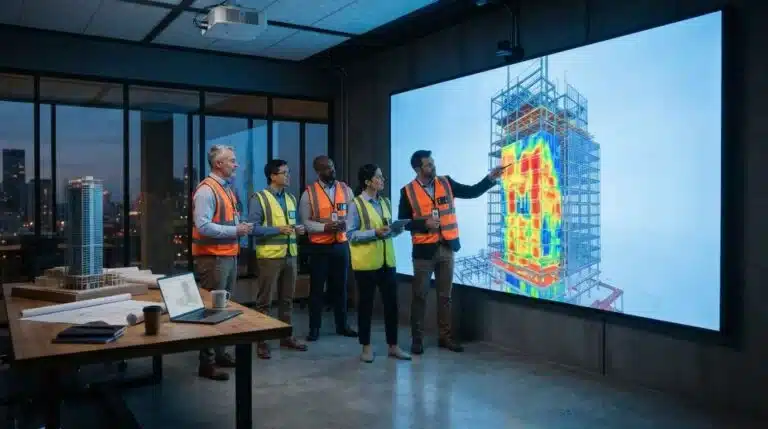
Pricing a construction project has always meant working with numbers that don’t sit still. Material costs shift between the time a budget is drafted and the time a project actually breaks ground, and a number that looked solid three months ago can be off by a meaningful margin by the time crews show up on site. AI construction cost forecasting is starting to close that gap by pulling in more current data and spotting cost trends before they show up as a painful surprise on a job.
This article looks at how AI-driven cost forecasting actually works, what the research says about its accuracy, and where a human estimator’s judgment still carries the most weight.
Why Traditional Cost Estimating Struggles to Keep Up
Most budgets are built using historical cost data — what a similar project cost last time, adjusted for size and scope. The problem is that construction material prices don’t move in a straight line. According to the Bureau of Labor Statistics‘ Producer Price Index program, which tracks output prices for construction sectors on a monthly basis, material and contractor markup costs are updated continuously precisely because they change often enough to matter for budgeting decisions.
When an estimator relies on a spreadsheet built from last year’s numbers, that budget starts going stale the moment it’s finalized. AI construction cost prediction tools were built to deal with exactly this kind of moving target, pulling from more current and more granular data than a static historical average can offer.
What Is AI Construction Cost Forecasting?
AI construction cost forecasting uses machine learning models to analyze historical project costs, current material pricing trends, and broader market indicators to predict what a project is likely to cost, both today and at some point in the future when the work will actually happen. Instead of a fixed markup applied to last year’s numbers, the model factors in patterns across many data points at once — something that’s difficult to do manually with any real consistency.
This falls under the wider umbrella of artificial intelligence construction costs research, which also includes work on labor cost modeling, cost overrun prediction, and risk-adjusted budgeting.
How AI Construction Cost Prediction Models Actually Work
Most AI cost forecasting platforms follow a similar general approach:
- Historical data collection — past project costs, broken down by trade, material, and labor, are compiled into a training dataset.
- Market data integration — current material price indices, labor rate trends, and regional cost variations are layered on top of historical data.
- Pattern and feature identification — the model identifies which variables (project size, location, material type, timeline) most strongly influence final cost.
- Forecast generation — based on those patterns, the model produces a cost estimate or a cost range for a specific project.
- Ongoing refinement — as new project data comes in, the model updates and adjusts its predictions over time.
This is what separates construction cost prediction built on machine learning from a traditional escalation formula. Rather than applying one flat percentage increase across the board, the model can account for the fact that steel might be trending differently than lumber, or that labor costs in one region are rising faster than material costs.
The Research Behind AI Cost Forecasting
This isn’t just a marketing claim — it’s backed by academic research. A PhD study conducted through the Georgia Institute of Technology developed machine learning methods specifically to model and predict variation in U.S. highway construction costs, comparing them against traditional regression analysis and time series models. The research found that machine learning approaches were better able to capture non-linear relationships in cost data — patterns that standard linear models tend to miss — and noted that even small improvements in forecasting accuracy can translate into meaningful impact on actual project budgets.
That distinction matters. Construction costs don’t move in tidy, predictable patterns. A shortage in one material, a shift in fuel prices, or regional labor demand can all move costs in ways a simple formula won’t catch, but a model trained on enough varied data has a better shot at recognizing those shifts early.
Where Construction Cost Data Analysis Adds the Most Value
Earlier, more realistic budget planning. Owners often need cost estimates before design is finalized. AI-driven forecasting can give a more realistic range at the conceptual stage, based on patterns from similar past projects rather than rough rules of thumb.
More competitive, better-supported bids. When material costs are trending upward, knowing that ahead of time lets an estimator build in the right contingency without either overpricing a bid or getting caught underpriced later.
Smarter contingency planning. Instead of applying a flat contingency percentage to every project, cost data analysis can help identify which specific cost categories carry the most volatility risk, so contingency gets allocated where it’s actually needed.
Faster response to market shifts. When material pricing data updates regularly, forecasts can be adjusted mid-project rather than waiting for the next full re-estimate.
Limitations of AI Construction Budget Forecasting
It’s worth being direct about where this technology has real limits. Machine learning models are only as good as the data behind them, and sudden, unprecedented events — a new tariff, a supply chain disruption, a natural disaster affecting a regional supplier — aren’t always reflected in historical patterns. A model trained on the last ten years of data won’t necessarily see a genuinely new kind of shock coming.
AI construction budget forecasting also depends heavily on having enough clean, consistent historical data to train on. Smaller companies or unusual project types with limited historical records may see less reliable predictions than larger firms with years of standardized cost data behind them. This is why forecasts from these tools work best as an input to an estimator’s judgment, not a replacement for it.
How This Fits Into the Bigger Estimating Workflow
Cost forecasting doesn’t happen in isolation. It depends on accurate AI blueprint analysis to understand what’s actually being built, and it works hand in hand with construction quantity extraction, since forecasting is only useful once real quantities are known to apply pricing against. All of this ties back to the broader shift we cover in our guide to construction estimating with AI.
Why a Skilled Construction Cost Estimator Still Matters
Forecasting tools can flag trends and surface risk faster than a manual review ever could, but deciding how to actually respond to that information — how much contingency to build in, which supplier relationships might soften a price increase, when a forecast doesn’t match what’s happening on the ground — still takes a person who understands the market. That’s exactly the value an experienced construction cost estimator brings: using the data these tools provide while applying judgment that no model can fully replace.
Frequently Asked Questions
How accurate is AI in predicting construction costs?
Research has shown machine learning models can outperform traditional regression and time series methods, particularly for capturing non-linear cost patterns. Accuracy still depends on the quality and volume of historical data available.
Can AI predict sudden material price spikes?
Not reliably. AI models are strong at recognizing patterns in historical and current data, but sudden shocks like tariffs or supply disruptions are harder to predict since they often don’t follow past trends.
Does AI cost forecasting replace the need for an estimator?
No. It gives estimators better data to work with, but decisions about contingency, risk, and how to respond to market shifts still require human judgment and industry experience.
Final Thoughts
Construction costs rarely stay still long enough for a static spreadsheet to keep up, and that’s exactly the gap AI construction cost forecasting is built to close. It won’t predict every market shock, and it isn’t a substitute for an estimator who understands the specific risks of a project. But used well, it gives budgeting teams a clearer, more current picture of where costs are heading, which makes for stronger, more defensible numbers from the very first estimate.