
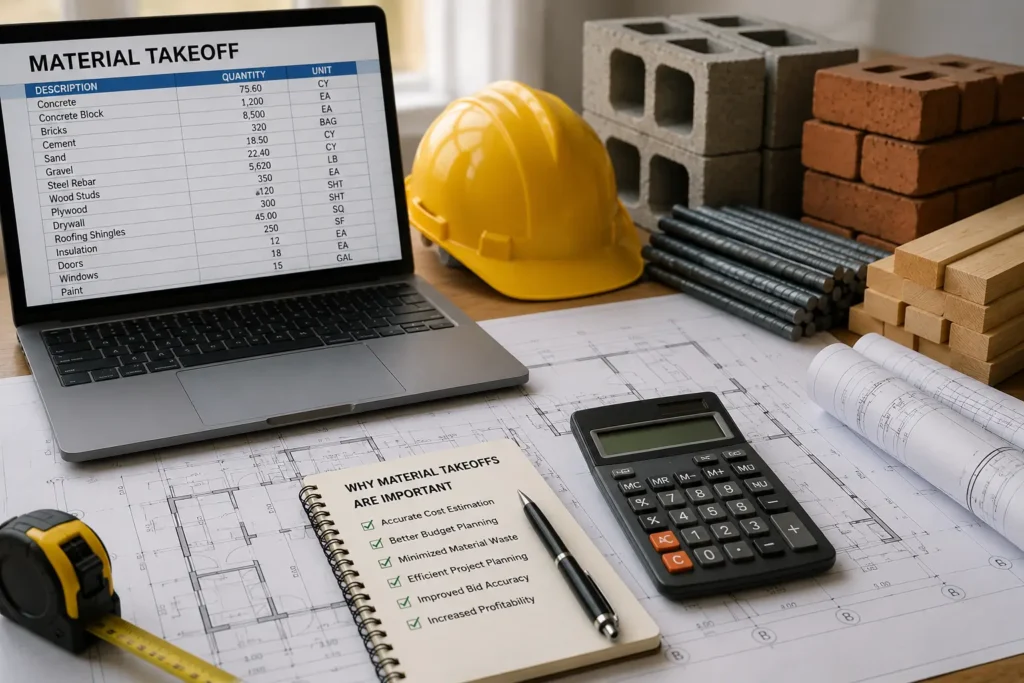
Ask any experienced contractor what separates a profitable project from a losing one, and quantities usually come up before schedules or labor rates ever do. Get the numbers wrong at the start, and everything downstream — budgets, timelines, supplier relationships — starts to wobble. That’s exactly why the material takeoff isn’t just a paperwork formality; it’s one of the most influential steps in the entire material takeoff process.
In this article, we’ll look at why are material takeoffs important in construction project so much, the tangible benefits they bring to a project, and how they tie directly into planning and profitability.
Importance of Material Takeoff
A material takeoff is the bridge between design and reality. Architectural drawings show what a building should look like, but they don’t tell you how many studs, how much concrete, or how many linear feet of pipe it will actually take to build it. That’s the job of the takeoff.
Without an accurate takeoff, everything that follows is built on guesswork:
- Bids become unreliable, either too high to win the job or too low to make a profit.
- Procurement teams order the wrong quantities, causing delays or excess inventory.
- Project timelines slip because materials arrive late or in the wrong amounts.
- Client trust erodes when budgets balloon mid-project due to “unexpected” material costs that were, in reality, just missed the first time around.
In short, the takeoff sets the tone for how predictable — or chaotic — the rest of the project will be.
Benefits of Material Takeoff
Beyond simply avoiding disaster, a well-executed material takeoff brings real, measurable advantages to a construction project:
1. More accurate bidding Contractors who takeoff carefully can submit bids that reflect true costs, which means fewer surprises for both the client and the contracting team once work begins.
2. Reduced material waste Knowing precise quantities — including realistic waste factors — helps avoid over-ordering materials that end up sitting unused, or worse, thrown away.
3. Better supplier negotiations When you know exactly what you need and when, you’re in a stronger position to negotiate pricing and delivery schedules with suppliers.
4. Improved cash flow management Accurate takeoffs let project owners and contractors plan spending in phases, rather than tying up capital in materials that won’t be used for weeks.
5. Fewer costly errors A careful takeoff process naturally catches discrepancies between drawings and specifications before they become expensive change orders. It also helps teams avoid the kind of common material takeoff errors that tend to resurface project after project when this step is rushed.
Role of Material Takeoff in Construction
The material takeoff touches nearly every phase of a construction project, not just the estimating stage:
- Pre-construction – Used to generate accurate bids and secure financing based on realistic cost projections.
- Procurement – Guides purchasing decisions, delivery scheduling, and supplier selection.
- Scheduling – Helps project managers sequence work based on material availability and lead times.
- On-site management – Acts as a reference point for site supervisors to confirm deliveries match what was ordered.
- Cost tracking – Serves as a baseline to measure actual spending against the original estimate throughout the build.
Because it influences so many downstream decisions, many firms rely on a professional building materials estimator rather than treating the takeoff as an afterthought squeezed in before a bid deadline.
Material Takeoff and Project Planning
Project planning and material takeoffs are deeply connected — arguably, one can’t be done properly without the other. A realistic project schedule depends on knowing when materials will be needed and how long they’ll take to source. A realistic budget depends on knowing exactly what those materials will cost.
When takeoffs are done early and accurately, project planners can:
- Sequence trades and deliveries so materials arrive exactly when needed, minimizing on-site storage issues.
- Identify long-lead-time items early, giving enough runway to place orders before they become a bottleneck.
- Build contingency budgets based on real quantities rather than rough guesses.
- Avoid the ripple effect of one missed item throwing off multiple trade schedules down the line.
For a full breakdown of exactly what a takeoff should contain, our guide on the material takeoff items list is a useful next stop.
FAQs
1. How does a material takeoff affect project cost overruns?
Most cost overruns can be traced back to inaccurate or incomplete quantity estimates. When a takeoff misses items, underestimates waste, or uses outdated pricing, those gaps show up later as unplanned expenses — often at a point in the project when there’s little flexibility to absorb them.
2. Why Are Material Takeoffs Important for Small Construction Projects?
Yes. Material takeoffs are important even for small construction projects because there is often less room in the budget for material errors. Accurate quantities help contractors control costs, plan purchases, reduce waste, and keep smaller projects on schedule.