
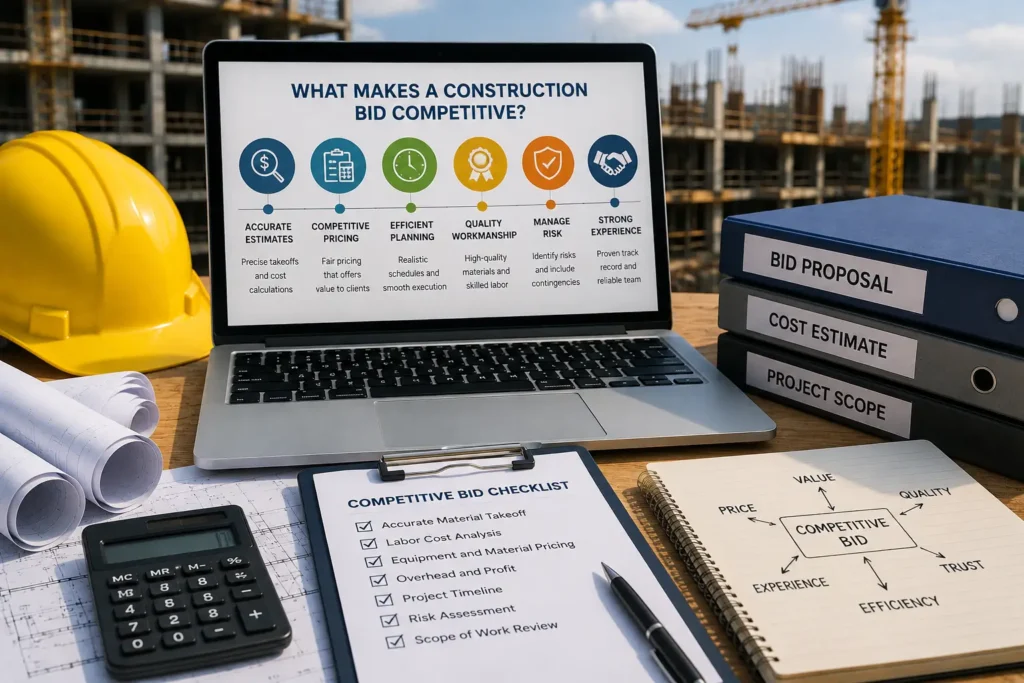
Contractors lose bids for reasons that have nothing to do with price. A bid can be the cheapest one on the table and still get rejected, because the person reviewing it doesn’t trust the number. Understanding what actually makes a competitive construction bid work is less about beating everyone else on cost, and more about building a bid a client or GC can say yes to with confidence.
Most contractors chase the wrong metric. They shave their margin to hit a lower number, win the job, and then struggle to finish it profitably. A genuinely competitive bid balances four things at once: price, credibility, clarity, and timing. Miss any one of them, and even a well-priced bid can end up in the reject pile.
Why “Cheapest” and “Competitive” Aren’t the Same Thing
When an owner opens a stack of bids, the lowest number rarely wins on its own. In fact, a bid that comes in noticeably below everyone else often gets a second, more skeptical look. Reviewers start asking questions: did this contractor miss something in the scope? Are they planning to cut corners on materials? Will change orders start piling up once the project begins?
That skepticism is usually earned. Underpriced bids are one of the most common reasons projects end up in disputes later. A bid that looks too good to be true, usually is. The goal isn’t to be the cheapest bid in the pile — it’s to be the one that looks accurate, complete, and realistic enough that the reviewer doesn’t have to guess.
Understanding what does a construction bid consist of helps explain why this happens. Every section of a bid, from the scope breakdown to the stated exclusions, sends a signal about how carefully the estimator did their homework.
Factors That Win Construction Bids
A handful of things consistently separate the bids that get shortlisted from the ones that get skipped over.
Scope accuracy comes first. If a contractor misreads the drawings or skips the site visit, the entire bid is built on a shaky foundation before a single number gets entered. Owners and GCs can usually tell when a bid was rushed, because the assumptions don’t line up with the actual project.
Pricing transparency comes second. A single lump-sum figure with no breakdown asks the reviewer to trust blindly. A bid itemized by labor, materials, equipment, and subcontractor costs does the opposite — it shows the math, which builds confidence even before the total gets compared to competitors.
Cost estimating discipline ties the whole thing together. This is the part of the process most likely to get rushed under deadline pressure, and it’s also the part most likely to sink a project financially if it’s wrong.
Track record matters more on larger or unfamiliar project types. A contractor who can point to similar completed work, delivered on time and on budget, removes a layer of risk from the owner’s decision.
Timeline realism is often overlooked. A schedule that sounds fast but isn’t backed by a real crew plan tends to unravel at the first delay, and reviewers who’ve been burned before can usually spot an inflated timeline from experience.
Clear assumptions and exclusions protect everyone involved. Spelling out what isn’t included, and under what conditions the price could change, heads off disputes that would otherwise surface mid-project.
How to Price a Competitive Bid
Pricing a bid well is part measurement, part judgment.
It starts with an accurate quantity takeoff pulled directly from the drawings, not estimated by eye. Every material, every labor hour, and every piece of equipment time should trace back to something measurable in the plans.
From there, price it using current data rather than whatever numbers were used on the last job. Material and labor costs move constantly, sometimes month to month, and a price list that’s even a few months old can throw off an entire bid. RSMeans has been the construction industry’s reference point for unit cost data since the 1940s, and it’s worth understanding how a database like that gets researched and updated, even for contractors who price jobs manually.
Overhead and profit margin come next, and this is where discipline matters most. Cutting margin to win a job “at all costs” is a short-term fix that causes long-term damage — either the project loses money, or corners get cut that hurt the contractor’s reputation on the next bid.
Finally, price in the risk that’s specific to the project. Site access problems, an unusually tight schedule, or an unfamiliar permitting process should all show up in the number, not get absorbed silently and hoped away.
Common Bidding Mistakes to Avoid
Even experienced contractors fall into a few repeat traps.
Rushing the takeoff to save time upfront almost always costs more later, once missed quantities surface mid-project.
Assuming a crew will work faster than its realistic average productivity is one of the most common ways a bid quietly loses money before the first day on site.
Skimming the bid documents instead of reading them closely is another frequent mistake. Missed specifications or addenda can turn what looked like a winning bid into a losing project. Standard reference documents like the AIA’s Instructions to Bidders (A701) exist specifically because so many disputes trace back to unclear or overlooked bid conditions.
Indirect costs get forgotten more often than they should. Permits, mobilization, insurance, and cleanup rarely show up in a first-draft budget, but they add up fast once itemized properly.
And a strong bid submitted late is worth nothing. Deadlines in construction bidding are rarely flexible, and a missed submission window eliminates even the best-priced proposal on the table.
Building a Repeatable Process
The contractors who win consistently aren’t relying on instinct every time. They’re following a bid preparation checklist that forces a final review of scope, pricing, and documentation before anything goes out the door. A repeatable process built around a clear construction estimating and bidding workflow removes most of the mistakes above simply by making them harder to skip.
It also helps to understand the broader Bidding Process Construction teams can repeat project after project, from the initial invitation through to a signed contract, since a well-priced bid still has to move correctly through every stage to actually close the deal. And behind almost every strong bid is solid estimating support — understanding how estimators support contractors throughout that process is often the real difference between a bid built on measured numbers and one built on guesswork.
Frequently Asked Questions
What’s the single biggest factor in winning a construction bid?
Accurate cost estimating. A bid can have a strong track record and clear terms, but if the underlying numbers are outdated or incomplete, it will either lose on price or win and become unprofitable.
Can a bid be competitive without being the lowest price?
Yes. Transparency, a realistic timeline, and clear documentation often matter as much to a reviewer as the final number, especially on larger or more complex projects.