
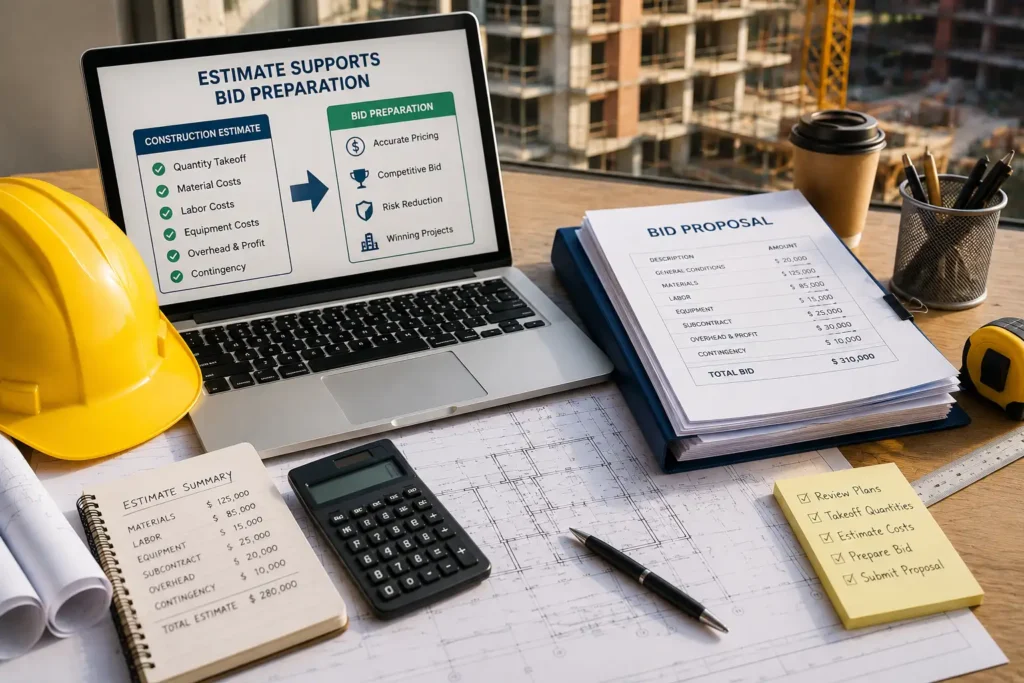
Winning a construction project rarely comes down to luck. It comes down to numbers — accurate, well-researched numbers that tell a client exactly what a job will cost and why. This is where Construction Estimating For Bidding becomes the backbone of every successful proposal. Without a solid estimate, even the most experienced contractor is essentially guessing, and guessing doesn’t win contracts in a market where margins are thin and competition is fierce.
In this article, we’ll break down how Construction Estimating For Bidding shapes the outcome of every proposal, why cost estimation matters so much, and how estimators actively help contractors turn a rough idea into a winning bid.
What Is Construction Estimating for Bidding?
At its core, construction estimating for bidding is the process of calculating the total expected cost of a project before any work begins. This includes materials, labor, equipment, subcontractor pricing, permits, overhead, and profit margins. The estimate becomes the foundation of the bid document that’s submitted to the project owner.
A bid isn’t just a number pulled out of thin air — it’s the result of careful analysis of drawings, specifications, site conditions, and market pricing. When done correctly, bid preparation estimates give contractors the confidence to submit a price that’s competitive without cutting into profitability.
The Role of Cost Estimation in Bidding
The role of cost estimation in bidding goes far beyond simply adding up numbers. It directly influences whether a contractor wins or loses a project, and it protects the business from underbidding or overbidding.
Here’s why cost estimation matters so much during the bidding stage:
- It sets a realistic price point. Owners compare multiple bids, so pricing needs to be accurate enough to stay competitive while still covering true costs.
- It reduces financial risk. A poorly estimated bid can lead to cost overruns that eat into profit or even cause losses.
- It builds trust with clients. Detailed, transparent estimates show owners that a contractor understands the scope of work.
- It supports negotiation. When estimates are broken down clearly, contractors can justify pricing if the owner pushes back.
Cost estimation essentially acts as the financial map for the entire project — before a single shovel hits the ground.
What Goes Into Construction Cost Estimates
Reliable construction cost estimates are built from several layers of data, not just a single lump-sum guess. Estimators typically account for:
- Material costs — current market prices for lumber, steel, concrete, and other resources.
- Labor costs — wages, productivity rates, and crew sizes needed for each task.
- Equipment costs — rental or ownership costs for machinery required on-site.
- Subcontractor quotes — pricing gathered from specialty trades like electrical, plumbing, or HVAC.
- Overhead and indirect costs — insurance, permits, site supervision, and administrative expenses.
- Contingency allowances — a buffer for unforeseen issues like weather delays or price fluctuations.
- Profit margin — the markup that ensures the project is financially worthwhile for the contractor.
Each of these elements ties directly into the construction bid components that owners review when comparing proposals. Missing or underestimating even one category can throw off the entire bid.
How Estimators Support Contractors Throughout the Bid Process
A common misconception is that estimators simply “run the numbers” and hand off a spreadsheet. In reality, understanding how estimators support contractors reveals just how central their role is to winning work.
1. Reviewing Plans and Specifications
Estimators study blueprints, scopes of work, and technical specifications line by line to identify every cost driver, including details that might otherwise be overlooked.
2. Conducting Takeoffs
A quantity takeoff measures the exact amount of materials needed — square footage, linear feet, cubic yards — so pricing is based on real project data, not rough approximations.
3. Sourcing Accurate Pricing
Estimators reach out to suppliers and subcontractors to gather current pricing, since material costs can shift significantly depending on market conditions.
4. Identifying Risks Early
Experienced estimators flag potential issues, such as site access problems or tight timelines, before they become costly surprises during construction.
5. Structuring the Bid Package
Estimators organize the final numbers into a clear, professional format that aligns with the bidding process construction requires, making it easier for owners to evaluate the proposal.
By handling these responsibilities, estimators free up contractors to focus on strategy, client relationships, and project planning rather than getting buried in spreadsheets.
Why Accurate Estimates Lead to a Competitive Construction Bid
Submitting a competitive construction bid isn’t about offering the lowest price — it’s about offering the most accurate and justifiable price. Owners are often wary of bids that seem unusually low, since it can signal that the contractor missed something in their scope review.
Accurate estimating allows contractors to:
- Price projects with confidence instead of relying on rough guesswork
- Avoid change-order disputes caused by scope gaps
- Maintain healthy profit margins across multiple projects
- Build a reputation for reliability, which leads to repeat business
In a competitive bidding environment, the contractor with the most disciplined estimating process often has the edge — not necessarily the one with the lowest number.
Common Mistakes That Weaken Bid Preparation
Even experienced contractors can fall into estimating traps that hurt their chances. Some of the most frequent issues include:
- Relying on outdated material or labor pricing
- Skipping site visits before finalizing numbers
- Underestimating overhead and indirect costs
- Failing to include a contingency buffer
- Rushing the estimate due to tight submission deadlines
Strong Construction Bid Preparation starts with treating the estimate as a strategic document, not just a formality required to submit a proposal.
Final Thoughts
Construction estimates aren’t just a step in the bidding process — they’re the foundation that everything else is built on. From material takeoffs to labor calculations, every detail in an estimate shapes whether a bid is competitive, profitable, and realistic. Contractors who invest in accurate, detailed estimating consistently outperform those who treat it as an afterthought.
Whether you’re a general contractor or a subcontractor, understanding the connection between estimating and bidding puts you in a stronger position to win the right projects — not just more projects.
FAQs
1. Why is construction estimating important for winning bids?
Construction estimating gives contractors an accurate picture of total project costs, which allows them to submit a price that’s both competitive and profitable. Without a reliable estimate, contractors risk underbidding and losing money or overbidding and losing the project entirely.
2. What is the difference between a cost estimate and a bid?
A cost estimate is the detailed breakdown of expected project expenses, including materials, labor, and overhead. A bid is the final price submitted to the client, which is built directly from that estimate along with the contractor’s desired profit margin.